

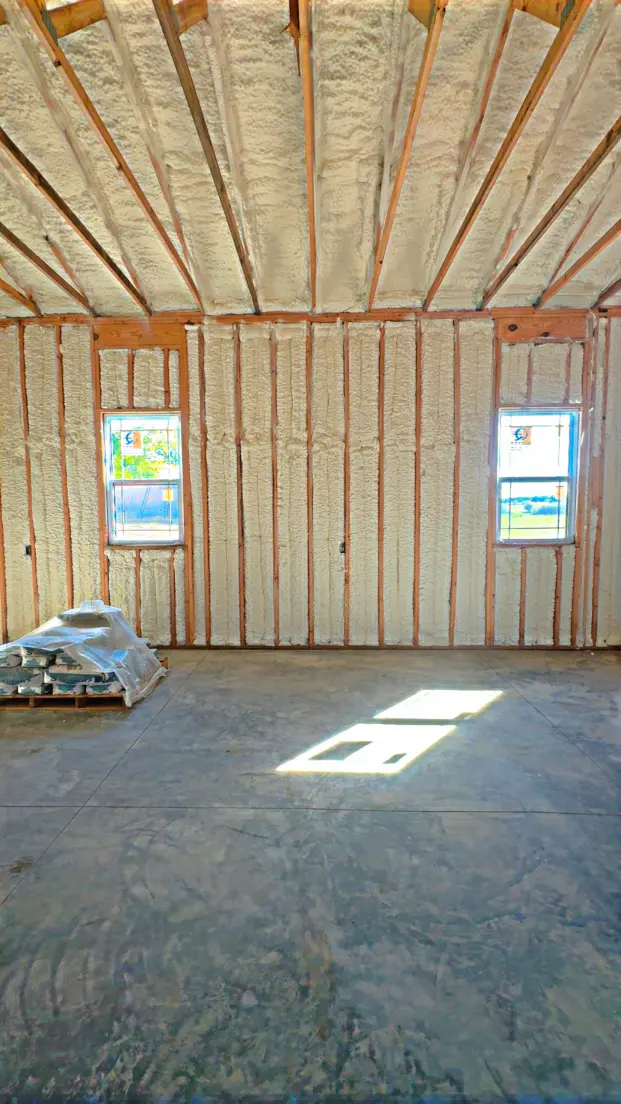
For a typical home in Licking, Missouri, budgeting between $2,000 and $7,000 for open-cell spray foam insulation covers most standard residential projects, with the average landing around $7,000 depending on square footage and application area. Larger homes, difficult-to-reach spaces, or projects requiring old insulation removal can push the total toward $20,000. The actual cost depends on the area being insulated, the thickness required to meet code, and site-specific conditions like attic accessibility or crawlspace clearance. Open-cell spray foam is the more budget-friendly option compared to closed-cell, and it delivers strong air sealing and sound dampening for interior applications, making it a practical choice for Licking homeowners looking to improve comfort and energy efficiency.
Open-cell spray foam is a light-density, semi-rigid insulation material created by mixing two liquid chemicals, isocyanate and polyol resin, which expand rapidly upon contact Spray Foam – Wikipedia. As the foam expands, its internal cell walls rupture, leaving behind a sponge-like structure filled with air rather than sealed gas pockets. This gives open-cell foam its characteristic softness and lower density, around 0.5 pounds per cubic foot.
The R-value of open-cell spray foam sits at approximately R-3.8 per inch, according to building science data from Johns Manville’s building insulation research. Compared to closed-cell foam at R-7 per inch, open-cell requires more depth to reach the same thermal resistance. However, open-cell fully expands to fill cavities, sealing gaps and crevices that traditional fiberglass batts cannot reach. This creates an effective air barrier when installed at 3.75 inches or greater, which is a significant advantage over conventional insulation that leaves gaps around framing and penetrations.
Open-cell spray foam also absorbs sound, making it a practical choice for interior partition walls and floors between living spaces. One trade-off is that open-cell foam does not act as a vapor barrier, so homes in humid climates like Missouri’s Zone 4A need a separate vapor retarder to prevent condensation issues within wall assemblies.
Licking, Missouri falls in Texas County, which is mapped to IECC Climate Zone 4A (Mixed-Humid) under the 2021 International Energy Conservation Code. This classification comes from the Building America Solution Center at Pacific Northwest National Laboratory, a U.S. Department of Energy resource that provides climate zone data by county. Zone 4A means Licking experiences winter design temperatures as low as 13 degrees Fahrenheit and summer highs reaching 91 degrees, creating a climate where both heating and cooling demands are significant.
The IECC prescriptive requirements for Zone 4A call for ceiling and attic insulation at R-49, wall insulation at R-20, and floor insulation at R-19. To meet the R-49 ceiling requirement with open-cell foam alone at R-3.8 per inch, roughly 13 inches of material would be needed, which is typically impractical and costly. In practice, open-cell spray foam is most often used in wall cavities and as part of a layered attic system, while other insulation types or hybrid approaches handle the ceiling.
For Licking homeowners, the humidity component of Zone 4A matters. Mixed-humid climates require careful vapor management. Since open-cell foam allows moisture vapor to pass through its porous cell structure, it can actually help walls dry toward the interior in certain assemblies, but a separate vapor barrier strategy must be planned with the installer.
Based on project data from the Licking, MO, here is a realistic budget range for open-cell spray foam insulation:
| Project Scope | Typical Low | Typical Average | Typical High |
|---|---|---|---|
| Open-Cell Spray Foam (general) | $2,000 | $7,000 | $20,000 |
| Attic Insulation | $2,500 | $5,000 | $15,000 |
| Crawlspace Insulation | $2,500 | $5,000 | $10,000 |
| Insulation Removal and Replacement | $5,000 | $10,000 | $30,000 |
These ranges reflect typical conditions for homes between 1,500 and 2,500 square feet. A small accent wall or targeted air sealing job can fall on the lower end, while a full-home insulation overhaul with removal of existing materials pushes toward the upper range.
Job type and scope drive the largest portion of your budget, but several other variables influence the final number. Understanding these helps you plan more accurately and avoid surprises during installation.
Factors that increase pricing:
Factors that lower pricing:
Not every insulation scenario calls for open-cell foam. Here is a breakdown of when it makes the most sense and when closed-cell or other materials may be better suited.
| Application | Open-Cell Foam | Why It Fits (or Doesn’t) |
|---|---|---|
| Interior wall cavities | Excellent | Fills cavities completely, provides sound reduction, seals air leaks at lower material cost |
| Attics (vented assemblies) | Good | Air seals penetrations and top plates; pair with blown-in insulation for full R-49 compliance |
| Crawlspace walls | Limited | Open-cell does not block moisture vapor; closed-cell is preferred for below-grade and crawlspace applications |
| Exterior continuous insulation | Not recommended | Only closed-cell foam provides the vapor barrier needed on exterior assemblies |
| Sound-dampening between rooms | Excellent | The porous structure absorbs airborne sound effectively |
For Licking homeowners building new construction or retrofitting existing homes, open-cell spray foam is most cost-effective when applied to interior walls and attic floor assemblies where air sealing and sound control are the priorities. It is less appropriate for crawlspaces, basements, and any application where direct exposure to moisture is likely.
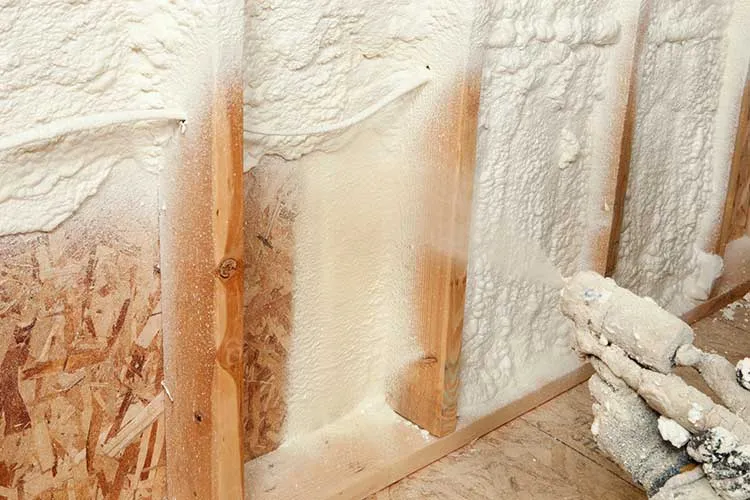
The U.S. Department of Energy estimates that 40% of a home’s energy is lost through air infiltration via walls, windows, and doorways, and buildings treated with spray foam insulation can perform up to 50% better than those insulated with traditional products Spray Foam – Wikipedia. The EPA’s ENERGY STAR program further estimates that sealing air leaks and adding insulation can save homeowners up to 20% on monthly energy bills ENERGY STAR – Air Seal & Insulate.
For Licking residents, where heating and cooling costs can be substantial across the Zone 4A temperature swing, these savings compound over time. Spray foam insulation also reduces the workload on HVAC systems, and research cited by the Spray Polyurethane Foam Alliance suggests HVAC sizing can be reduced by as much as 35% in homes properly insulated with spray foam, without sacrificing comfort.
Choosing the right installer matters as much as choosing the right material. Here are clear indicators of a professional, trustworthy spray foam contractor:
A contractor who communicates clearly, addresses vapor management, and scopes the job thoroughly is far more likely to deliver a result that performs as expected and lasts for decades.
Summit Thermal Solutions serves the Licking, MO area with professional open-cell or closed-cell spray foam insulation for residential and commercial projects. Our team evaluates your home’s specific needs, factoring in climate zone requirements, existing conditions, and your budget to recommend the right approach. Whether you are building new, retrofitting an older home, or addressing comfort and energy issues, we provide transparent pricing and clear communication from the first conversation through project completion.
Contact us today to discuss your insulation project:
📞 Call us: (573) 889-3512 📧 Email: [email protected]
Request a Free Quote | Schedule an Insulation Assessment
Open-cell spray foam works well in vented attic assemblies for air sealing the attic floor, but achieving the R-49 ceiling requirement with open-cell alone would require roughly 13 inches of material. It is often paired with blown-in insulation to reach code-compliant R-values cost-effectively.
Yes. Open-cell foam does not block moisture vapor, so in Zone 4A’s mixed-humid climate, a separate vapor retarder is recommended in wall assemblies to prevent condensation from forming within the cavity.
Most standard residential projects are completed within one to two days, depending on the total square footage and whether old insulation needs to be removed first. Weather conditions can also affect scheduling for exterior-adjacent work.
Open-cell foam is effective at reducing airborne sound transmission through interior walls and floors due to its porous, sound-absorbing structure. It is commonly used in home offices, media rooms, and shared walls between living spaces.
We handle projects as small as 100 square feet, making it feasible to address targeted problem areas like a single drafty room, a band joist, or a small attic section without insulating the entire home at once.