

If you have ever walked into a building that feels drafty in winter and sweltering in summer, you have experienced what poor insulation does to a structure. The air you feel moving through gaps around windows, under doors, and through attic floors is not just uncomfortable. It represents real money leaving your building every single day. Spray foam insulation is one of the most effective ways to stop that loss, and we have spent years working with this material across homes, commercial buildings, and agricultural structures in Missouri. This guide is built on that hands-on experience, combined with the latest building science research and industry standards.
Spray foam insulation is a chemical product created by mixing two components, called side A (isocyanate) and side B (polyol resin), at the tip of a spray gun. When these chemicals meet, they react and expand up to 30 to 60 times their liquid volume, creating a continuous layer of foam that fills cracks, crevices, and building cavities. According to Wikipedia‘s entry on spray foam, the material was first developed from polyurethane chemistry invented by Otto Bayer in 1937, with building insulation applications beginning around 1979. Today it stands as one of the highest-performing insulation options available, offering thermal resistance, air sealing, and moisture control in a single application.
To understand why spray foam performs so well, you need to understand how heat moves. Heat transfer happens through three mechanisms:
Conduction is the movement of thermal energy through a solid material. Think of a metal spoon in a hot cup of coffee. The handle gets warm because heat conducts through the metal. In buildings, conduction happens when heat passes through walls, roofs, and floors.
Convection is heat carried by moving air or fluid. Warm air rises and cold air sinks, which is why upper floors feel hotter in summer and colder air pools in basements during winter. Gaps and cracks in your building envelope allow convective heat loss to occur constantly.
Radiation is heat that travels in a straight line from a warm surface, much like the warmth you feel from sunlight on your skin.
Spray foam insulation addresses all three of these mechanisms. According to the U.S. Department of Energy’s Energy Saver guide, insulation works by providing resistance to heat flow, measured in R-value. The higher the R-value, the better the insulation resists conductive heat transfer. But spray foam goes a step further than most insulation materials. Because it expands to fill every gap and crack during installation, it also blocks convective heat loss by creating an airtight seal. And like most solid materials, spray foam is opaque to radiant heat transfer.
R-value measures thermal resistance, which is how well a material resists the flow of heat. The DOE’s Energy Saver guide explains that R-value depends on the type of insulation, its thickness, and its density. For spray foam specifically, the R-value per inch varies depending on whether you choose open-cell or closed-cell material.
Most common insulation materials resist conductive heat flow. But spray foam’s advantage is that it also fills building cavities completely, reducing air leakage and blocking convective heat loss at the same time. This dual action is what sets spray foam apart from fiberglass batts or blown cellulose, which can leave gaps that allow air to circulate.
The DOE recommends different R-values depending on your climate zone. For example, an uninsulated attic in climate zones 4 through 8 should reach R-60, while uninsulated wood-frame walls in those same zones need R-20 or more. The amount of insulation you need depends on your climate, your heating and cooling system, and the specific part of the building you are insulating.
Key Takeaways
This is the single most common question we get from building owners, and it matters because the two types behave very differently. Both start as a liquid mixture of isocyanate and polyol that expands when sprayed, but the internal structure of the cured foam is what separates them.
Open-cell spray foam, often called half-pound foam, expands significantly during application. The cells inside the foam are open, meaning air can pass through them. This gives the material a soft, sponge-like texture that you can compress by hand.
According to Johns Manville’s comparison of open-cell and closed-cell foam, open-cell spray foam has an R-value of approximately R-3.8 per inch and a density of about 0.5 pounds per cubic foot. When installed at 3.75 inches or greater, it acts as an effective air barrier. However, it does not function as a vapor barrier because air and moisture can infiltrate through its open cell structure.
Best uses for open-cell:
The porous structure of open-cell foam gives it superior acoustic performance compared to closed-cell foam. This makes it a strong choice for home theaters, bedrooms, offices, and any space where reducing airborne sound transfer matters.
Closed-cell spray foam, often called two-pound foam, has a much denser structure. The cells are sealed, trapping a low-conductivity gas inside. As noted by Wikipedia, closed-cell polyurethane foam has a Long Term Thermal Resistance (LTTR) R-value between 5.1 and 6 per inch. Johns Manville cites an even higher figure of approximately R-7 per inch for some products.
Beyond its higher R-value per inch, closed-cell foam serves as both an air barrier and a vapor barrier when installed at 1.5 inches or greater. It is rigid and adds structural strength to walls. Studies referenced on Wikipedia show that wall racking strength can double or triple when closed-cell foam is applied.
Best uses for closed-cell:
| Feature | Open-Cell Foam | Closed-Cell Foam |
|---|---|---|
| R-value per inch | ~3.8 | ~6.0 to 7.0 |
| Density | ~0.5 lb/ft³ | ~2.0 lb/ft³ |
| Air barrier at | 3.75 inches | 1 inch |
| Vapor barrier at | Not a vapor barrier | 1.5 inches |
| Expansion rate | Very high (up to 100x) | Moderate |
| Sound dampening | Excellent | Good |
| Structural strength | Low | High (doubles/triples wall strength) |
| Water resistance | Absorbs water | Resists water |
| Typical application | Interior walls, ceilings | Exterior walls, crawlspaces, roofs |
A common rule of thumb mentioned in Johns Manville’s guide is the “southern Pennsylvania border” dividing line. South of that line, open-cell foam is often sufficient because the temperature difference between indoor and outdoor air is smaller, often 30 to 40 degrees. North of that line, the temperature difference can reach 70 degrees or more, making the higher R-value and vapor barrier properties of closed-cell foam more important. That said, every building is different, and the right choice depends on your specific climate, structure, and budget.
Expert Tip: If your building has a history of moisture issues, condensation problems, or high humidity in crawlspaces, go with closed-cell foam. The vapor barrier alone can prevent the kind of hidden water damage that leads to mold and rot. Open-cell foam in a damp environment can actually hold moisture against wood framing, making problems worse.
Key Takeaways
Not every area of a building benefits equally from spray foam. Targeting the right locations maximizes your return on investment. Here are the areas where we see the greatest improvement in comfort and energy efficiency.
Attics are the single most common area where spray foam delivers dramatic results. In most homes, the attic is the hottest space in summer and the coldest in winter. Heat rises, so an uninsulated attic essentially acts as a funnel, pulling warm air out of your living space during heating months and radiating heat down through the ceiling during cooling months.
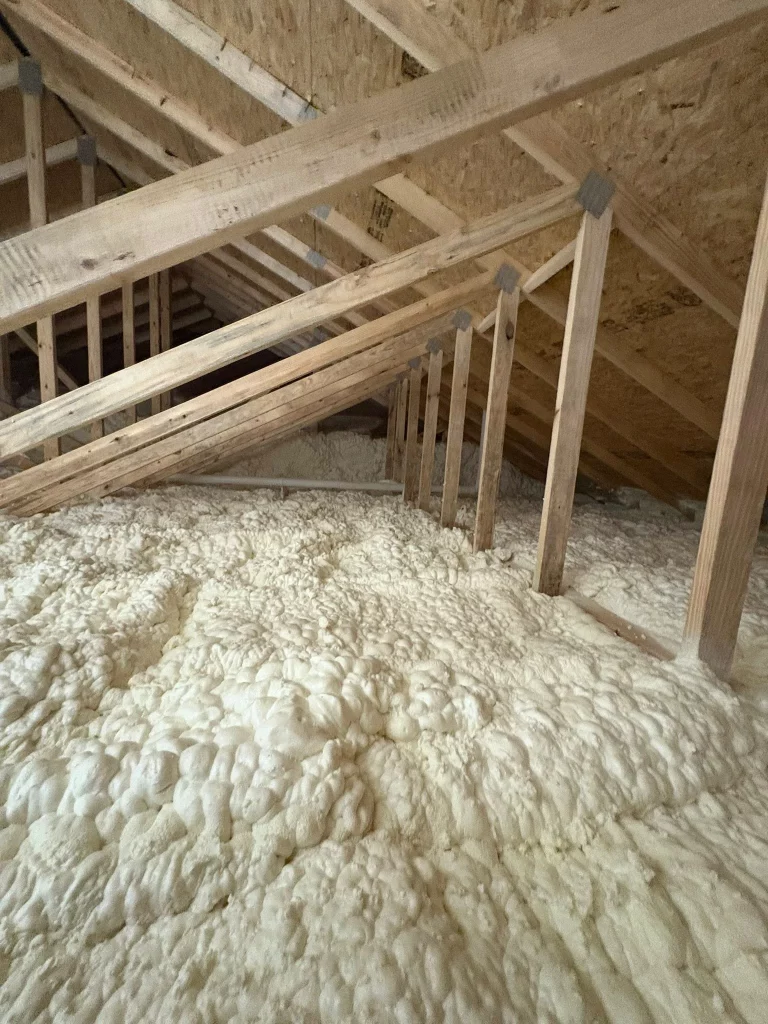
Spray foam applied to the attic floor seals around every framing member, electrical penetration, and plumbing vent. For newer construction, we also see spray foam applied directly to the underside of the roof deck, which brings the attic into the conditioned space. This approach is especially useful in homes with HVAC equipment or ductwork located in the attic.
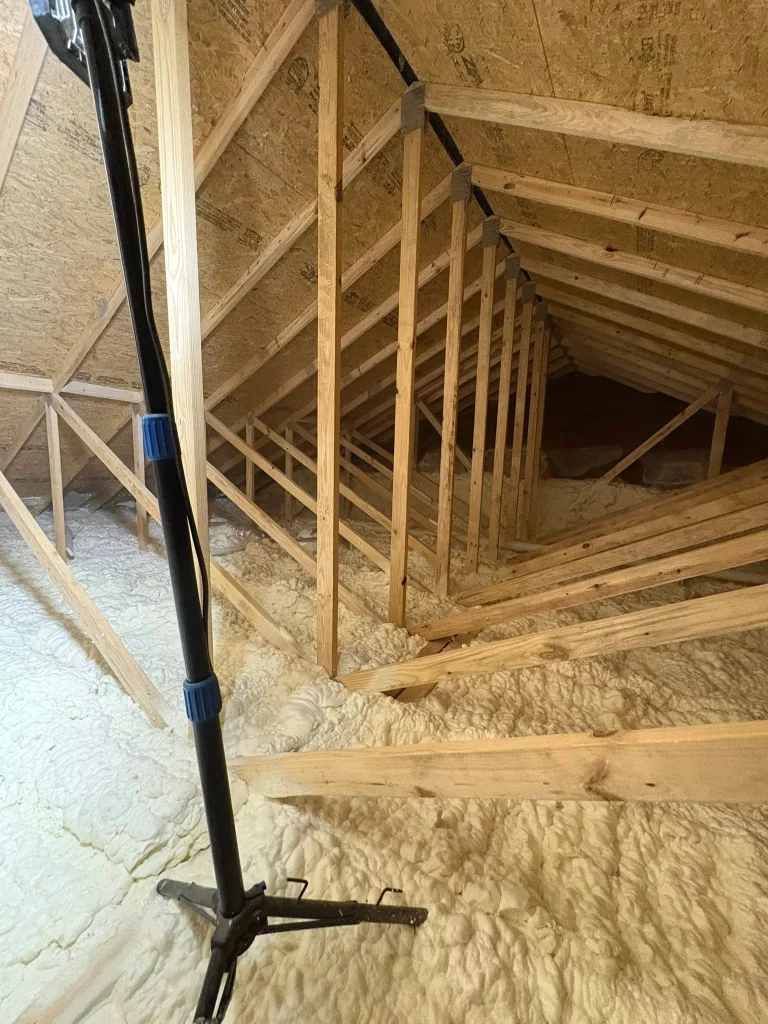
Crawlspaces are a trouble spot that many building owners overlook. Ground moisture evaporates upward into the crawlspace, and without a proper vapor barrier and insulation, that moisture finds its way into your floors and walls. Closed-cell spray foam applied to crawlspace walls and the floor joist area creates an airtight, moisture-resistant barrier that keeps ground humidity out and conditioned air in.
We regularly find that homeowners with insulated crawlspaces report warmer floors in winter, lower humidity throughout the house, and fewer musty odors. For commercial buildings with raised floors, the same principles apply.
Wall cavities are where air leaks cause the most frustration because the effects are felt directly in your living or working space. Drafty rooms, cold spots near windows, and uneven temperatures between floors often trace back to poorly sealed walls. Spray foam injected into existing wall cavities or applied in open wall cavities during new construction fills every gap and void, creating a continuous thermal and air barrier.
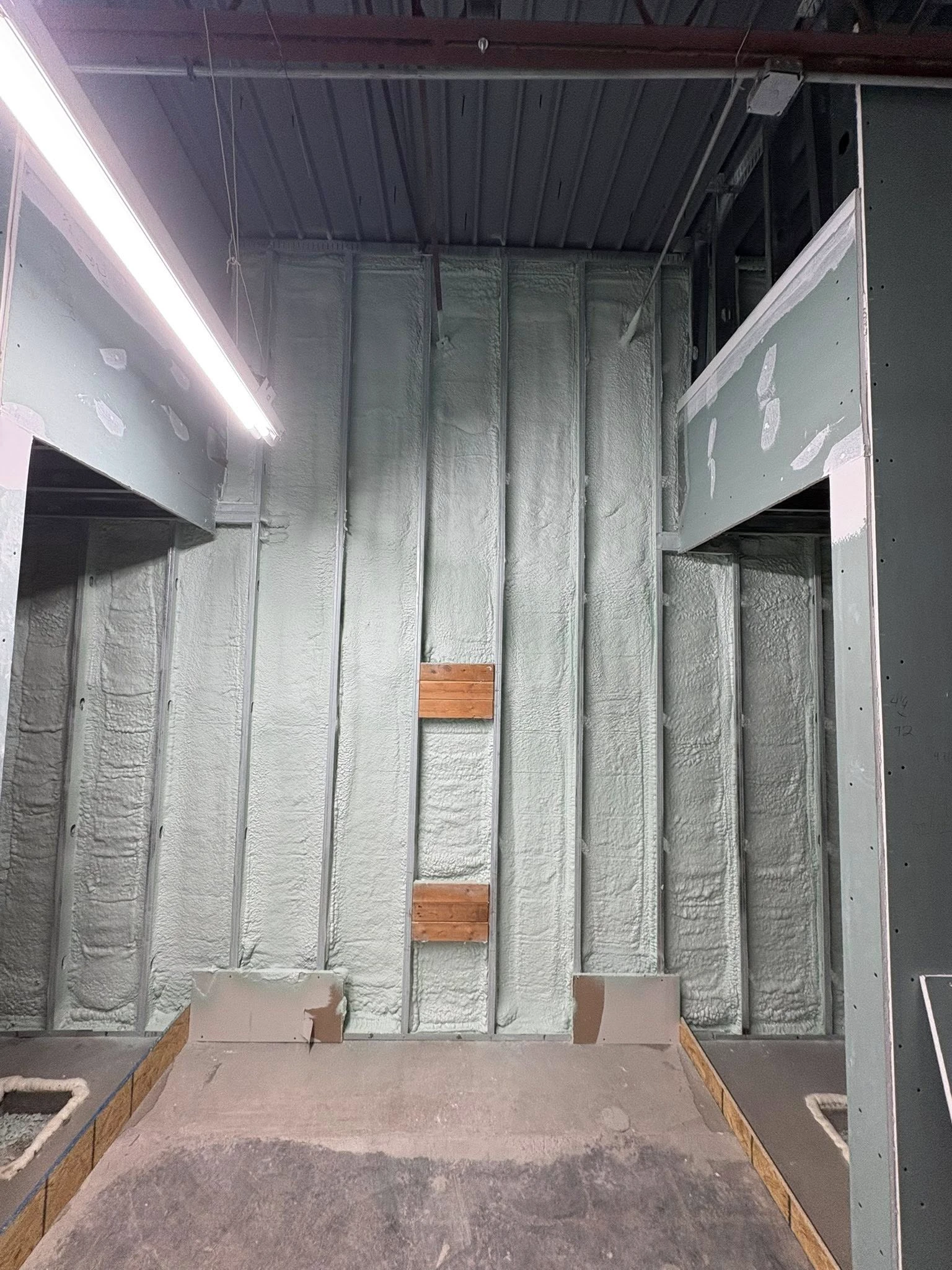
Metal buildings and pole barns present a unique insulation challenge. Metal transfers heat rapidly, making these structures extremely hot in summer and bitterly cold in winter. Traditional fiberglass batts do not adhere well to metal surfaces and leave gaps around screws, seams, and framing. Spray foam bonds directly to the metal substrate, sealing those joints and providing an effective thermal break.
Understanding the installation process helps you prepare your building and set realistic expectations. Here is what a typical spray foam project looks like from start to finish.
Every good project starts with an assessment. We evaluate the existing insulation, check for moisture damage, mold, or pest activity, and measure the areas to be treated. This is also when we determine the right foam type and thickness based on your climate zone, building construction, and performance goals.
Expert Tip: Before spray foam installation, make sure any existing moisture issues are resolved. Spray foam seals tightly, and trapping moisture behind it can lead to hidden rot and mold. If you see water stains, feel dampness, or smell musty odors, address those problems first.
The preparation phase is critical to a clean, effective installation. This involves:
During application, two technicians work as a team. One handles the spray gun while the other monitors the material supply and thickness. The chemicals are heated and mixed at the gun tip, and the foam expands rapidly on contact. Technicians build up the foam in layers to reach the target thickness, which typically ranges from 3 to 7 inches depending on the foam type and the required R-value.
For retrofit projects where wall cavities are already enclosed, small holes are drilled between studs, and a less aggressive expanding foam is injected to fill the void without damaging drywall.
Spray foam cures relatively quickly. Open-cell foam cures in minutes, while closed-cell foam may take several hours to fully cure. During and immediately after application, the work area must be well-ventilated. The foam emits vapors during the curing process, and occupancy should not resume until the installer confirms it is safe.
Once cured, the foam is trimmed flush with framing members, excess material is removed, and the area is cleaned. For wall applications, the holes from retrofit injection are patched and finished to match existing surfaces.
Expert Tip: Ask your installer how long they recommend waiting before re-occupying the space. Most professional installers follow strict re-occupancy protocols that account for ventilation rates, foam type, and the size of the area treated. If someone tells you it is safe to stay in the home during application, that is a red flag.
According to Wikipedia, studies by the U.S. Department of Energy show that approximately 40% of a home’s energy is lost through air infiltration via walls, windows, and doorways. Buildings treated with spray foam insulation can insulate up to 50% better than those using traditional insulation products.
Because spray foam both insulates and air seals, it reduces the workload on your HVAC system. Industry data suggests that HVAC sizing can be reduced by 25 to 35% in buildings insulated with spray foam, because the heating and cooling load drops so significantly. A smaller HVAC system costs less to purchase, less to operate, and lasts longer because it cycles less frequently.
The exact savings depend on several factors:
If you are considering spray foam insulation, timing matters for financial reasons. ENERGY STAR’s federal tax credit page shows that homeowners can claim a tax credit of 30% of the product cost for insulation materials and air sealing systems, up to $1,200, through December 31, 2025. The insulation credit falls under the broader Energy Efficient Home Improvement Tax Credit, which has an annual aggregate limit of $3,200 for all qualifying improvements.
To qualify, the insulation must meet specific performance criteria and be installed in an existing home that serves as your principal residence. New construction does not qualify. The credit is claimed using IRS Form 5695 when you file your federal income taxes.
Expert Tip: Combine your insulation upgrade with a home energy audit and you can claim the audit credit too, up to $150. The audit helps identify exactly where your building loses the most energy, so you can prioritize the areas where spray foam will have the greatest impact.
Spray foam insulation is highly effective, but it does involve working with reactive chemicals during installation. Understanding the safety profile helps you make informed decisions and ensure proper installation practices.
The two chemical components in spray foam, isocyanate (side A) and the polyol blend (side B), require careful handling. The EPA’s archived guidance on spray polyurethane foam warns that isocyanates are powerful irritants to the eyes, skin, and respiratory tract. Exposure can cause asthma and sensitization, meaning some individuals may develop allergic reactions even to very low concentrations after initial exposure. The EPA notes that there is no recognized safe level of exposure to isocyanates for sensitized individuals.
During spraying, the EPA notes that inhalation exposures typically exceed OSHA occupational exposure limits, requiring proper skin, eye, and respiratory protection. This is why spray foam should always be installed by trained professionals wearing appropriate personal protective equipment, including supplied-air respirators, protective suits, and gloves.
Once fully cured, spray foam is inert and non-toxic. It does not off-gas or release chemicals into the indoor environment. The curing time is relatively short, ranging from minutes for open-cell foam to several hours for closed-cell foam. After curing is complete and the area has been properly ventilated, the foam is safe for building occupants.
Spray foam’s environmental profile involves a trade-off. On one hand, it delivers significant energy savings over the life of the building, reducing greenhouse gas emissions from heating and cooling. On the other hand, the blowing agents historically used in closed-cell foam have been hydrofluorocarbons (HFCs), which have high global warming potential.
The industry has been transitioning toward lower-impact blowing agents. As noted on Wikipedia, a 2015 EPA rule under the Significant New Alternatives Policy (SNAP) program regulated the phase-out of certain high-GWP blowing agents, and some manufacturers have started using hydrofluoroolefin (HFO) blowing agents as alternatives. These newer-generation foams have a much smaller climate impact.
The spray foam industry has been growing steadily as building owners and contractors recognize the performance advantages over traditional insulation. According to Grand View Research’s spray foam market report, the global spray foam market was valued at approximately $2.34 billion in 2023 and is projected to reach $3.63 billion by 2030, growing at a compound annual growth rate of 6.5%.
Several trends are driving this growth:
After years of spray foam projects, we have seen what can go wrong when corners are cut. Here are the most common mistakes and how to avoid them.
Applying spray foam over existing moisture problems is one of the costliest mistakes a building owner can make. Foam seals tightly, and any moisture trapped behind it has nowhere to go. This can lead to wood rot, mold growth, and structural damage that may not become visible for years.
Before insulating, inspect for water stains, condensation, roof leaks, and foundation moisture. Fix any issues you find before the foam goes in.
Choosing open-cell foam for a crawlspace or basement where a vapor barrier is needed will lead to moisture problems. Choosing closed-cell foam for an entire interior wall system in a mild climate may be unnecessary and expensive. Matching the foam type to the application is essential.
Spray foam only delivers its rated R-value when installed at the correct thickness. Thinner applications mean lower R-value and, in the case of open-cell foam, may not achieve air barrier performance. Always verify that the installed thickness matches the specifications.
Spray foam application requires specialized training, equipment, and safety knowledge. Installers must understand chemical handling, temperature control, spray technique, and re-occupancy protocols. An inexperienced applicator can leave voids, apply uneven thickness, or expose building occupants to unnecessary risk.
Spray foam changes the ventilation dynamics of a building. In tight, well-sealed homes, mechanical ventilation becomes more important to maintain indoor air quality. If your building did not have mechanical ventilation before, adding spray foam may make it necessary.
Expert Tip: Always ask potential installers about their training, certifications, and insurance. A qualified installer will be happy to walk you through their safety protocols, the products they use, and the warranty they provide. If they cannot answer basic questions about R-values, curing times, or re-occupancy, look elsewhere.
For homeowners, spray foam is most commonly applied in attics, crawlspaces, and exterior walls. The result is a more comfortable living space with fewer drafts, more even temperatures from room to room, and lower energy bills. In new construction, spray foam allows for smaller HVAC systems and more design flexibility because less wall cavity depth is needed to meet insulation requirements.
Commercial buildings benefit from spray foam in several ways. Metal roofs and walls, which are common in warehouses, retail spaces, and office buildings, transfer heat rapidly without proper insulation. Closed-cell spray foam applied to metal surfaces provides thermal resistance, air sealing, and condensation control. For commercial buildings, energy efficiency directly affects operating costs, making spray foam a practical investment with measurable returns.
Pole barns, equipment sheds, and livestock buildings present harsh thermal environments. Without insulation, these structures swing wildly in temperature. Spray foam adheres to metal roofing and siding, seals around every fastener and joint, and maintains its performance over time despite the temperature fluctuations these buildings experience.
Spray foam insulation is one of the most effective investments you can make in your building’s comfort, durability, and energy efficiency. It works by providing thermal resistance through high R-values, creating an airtight seal that eliminates drafts and convective heat loss, and, in the case of closed-cell foam, adding moisture control and structural reinforcement.
Choosing the right type of foam, targeting the right areas of your building, and working with a qualified installer are the three decisions that will determine the success of your project. The federal tax credit available through 2025 makes this a good time to act, and the long-term energy savings continue to pay dividends for as long as you own the building.
We encourage you to bookmark this guide and use it as a reference as you plan your insulation project. Whether you are building new, retrofitting an older home, or insulating a commercial or agricultural building, the principles covered here apply across the board.
If you are ready to explore spray foam insulation for your home or business, we are here to help. Summit Thermal Solutions offers professional assessments to identify the right approach for your specific building and goals. Reach out to us at [email protected] or call (573) 889-3512 to discuss your project.
When properly installed, spray foam insulation lasts the lifetime of the building. It does not settle, sag, or degrade the way fiberglass batts can over time.
Yes. For walls, technicians drill small holes between studs and inject foam into the cavities. For attics and crawlspaces, the foam is sprayed directly onto surfaces. Both approaches work well for retrofit projects.
Once fully cured, spray foam is inert and non-toxic. It does not release harmful chemicals or gases. The curing process typically takes minutes to several hours depending on the foam type.
Most building owners see a measurable reduction in heating and cooling costs after spray foam installation. The savings depend on your climate, building size, existing insulation condition, and the areas treated.
Open-cell spray foam is particularly effective at reducing airborne sound transmission between rooms and floors. Closed-cell foam provides some sound reduction but is not as effective as open-cell for acoustic applications.
When installed correctly on dry surfaces, spray foam helps prevent moisture problems by sealing out humid air. However, applying foam over existing moisture can trap it and cause damage. Always inspect for and resolve moisture issues before installation.